Monday, 23 October 2017

Desktop Sharing to a Million Participants with RHUB's Live Streaming Servers

RHUB's secure Live Streaming Server supports HD audio/video/desktop live streaming for up to a million participants, for those critical "All Hands" meetings. It eliminates high internet bandwidth burden thanks to on-premise, CDN deployment fully utilizing the company's LAN. Participants can quickly and easily join sessions from any computer or mobile device (IOS or Android) via browser. Collaboration Technologies is a European Distributor for RHUB Communications. 
The Live Streaming server enable multiple panellists from anywhere over the internet to engage large audiences via sharing desktop, HD video and audio. The host can assign any panellist to present and all panellist can collectively answer any questions from participants in real-time. 
All RHUB servers run on-premise providing the ultimate security for important meetings such as financial presentations, proprietary corporate training and many more. 
RHUB Live Streaming reduces streaming delay from typical 40 seconds to 3 seconds enabling interactivity via chat and polling. This interactivity improves the meeting experience for all participants. 
"The ability to daisy chain servers makes this system ideal for companies with multiple campuses that wish to hold company-wide meeting such as "All Hands". The companies no longer need to consume high internet bandwidth to support large meetings. Each campus can have one or more servers to redistribute the live streaming content to local networks," said David Coleman, Senior Analyst at Collaborative Strategies, Inc. 
RHUB provides award winning on-premise, real-time collaboration servers that allow workgroups to: quickly host secure internal meetings with co-workers: for sales reps to host external sales presentation with clients: for thought leaders to facilitate educational webinars and training sessions; for companies to hold all-hands meeting with up to one million employees: for IT pros to conduct remote support sessions to manage computer tech issues and for workers to remotely access their desktops in office or home while on-the-go, and more. 
About RHUB Communications
RHUB Communications is a premier provider of real-time collaboration servers for hosting web conferences, video conferences, audio conferences and live streaming, remote support and remote access sessions. RHUB have over four million end users in a variety of market segments including: services, manufacturing and government. For more information, visit: http://www.collaboration-technologies.co.uk/.
 Contact:
Collaboration Technologies LTD
telephone: +44-(0)-1925-659-523
email: rhub@collaboration-technologies.co.uk
SOURCE Collaboration Technologies Ltd

Friday, 6 October 2017

Why Video Calling is the Best way to Build Trust in the Virtual Workplace

In descending order, in-person contact, video calling, audio calling and text messaging/emails are the most effective means of communication for building trust according to a research of Michigan University

When the going gets tough, talking face-to-face with your opponentis the only way to get out of it in most situations. This shows the power and importance of in-person contacts in building trust among people. Now, there is scientific evidence that back up the validity of the expression “we’d better talk in private”: according to a research of the University of Michigan (http://www.business2community.com/communications/video-conferencing-formation-workplace-trust-01778381#Kt51pdUzWH4cJZL3.97) that purposely targets virtual workplaces,  face-to-face meetings are the most effective way to build trust among people and virtual meetings the next.

This is not surprising at all, as video conferences simply recreate the experience of a face-to-face meeting across distance. The strong development of this technology in the last years plays a great role, as today video conferencing ensures their users high quality video sessions that are able to perfectly replicate the experience of a meeting in the reality. To give an example, we mention the suite of video conferencing servers TurboMeeting of R-HUB (http://www.collaboration-technologies.co.uk/) that allows its users even to cooperate in real time with very low frame delay (some few seconds) and get an enhanced experience of telepresence. Even the smallest non-verbal message is preserved through the usage of these light and compact devices that can be comfortably placed on a shelf of your bookcase as little as they are and that are sold at a price that does not go over a thousand of dollars.

A strong point of video conferencing is that all the initiatives and actions that are recommended by experts to build trust (like recognizing excellences, for example, or task delegation) can be easily included in any working relation that is managed through video conferencing. In other words, video conferencing allows managers to transpose and utilize the same tricks and techniques they learnt in traditional workplaces in an utter natural way, without the need of more or less long periods of retraining to get used to a new technology.

The fact that video conferencing is a technology that assures managers a smooth transition from the traditional workplaces to the new digital workplaces is certainly one of its key-factor of success. According to Credence Research, the growth of video conferencing in workplaces is explosive, with an expected rate of increase per year of + 20% in the next few years: in other word, it is a real technological revolution.

In conclusion, video conferencing is a very effective way to build trust thanks to its capability to perfectly render the experience of a real in-person contact and the possibility to transpose all the recommended actions to build trust into the virtual workplaces. However, it works if we use video conferencing tools that are able to ensure superb HD quality and seamless image streaming like TurboMeeting.

Tuesday, 22 August 2017

How and Why Video-Conferencing is Reshaping Sales

Technology changes have always heavily impacted society and people’s daily life, and video-conferencing does not make exception. Let’s try to figure out how sales could become in a near future when the usage of video-conferencing would be massive.

Video-conferencing is one of the most promising technologies of today, as it is clearly proved by statistics. The global market for video-conferencing is projected to reach about 3 billion $ by 2020, with a growth rate of about 7.5% per year. Among video-conferencing users, companies are going to increase their share of usage massively, mainly for business meetings. According to a survey (source: https://www.pgi.com/blog/2014/07/7-statistics-video-conferencing/ ), 74% of B2C and 92% of B2B marketers already use this technology in their marketing efforts today, and this trend is largely on the increase. Therefore, a question that comes up spontaneously is how video-conferencing is going to reshape sales in the future.

1. Direct sales are going to die out
Video-conferences have made direct sales obsolete. Through video-conferencing, salesmen can have the same benefits of real-life meetings without the burdens and expenses. This is particularly true for overseas sales. Who would spend a fortune to meet a far potential customer, when the same result can be easily reached by a free Skype call?

2. Customers will prefer to avoid any direct human interaction
Today’s buyers are able to make decisions without the help of a representative, as they can find all the information they need themselves. According to a research published on the Harvard Business Review (https://hbr.org/2012/07/the-end-of-solution-sales ), 60 % of buying decisions occurred before speaking to a sales man. It seems that nowadays the task of representatives is different from giving information to their customers.

On the other hand, video-conferencing makes presentations easy and inexpensive. A video-conferencing server of R-HUB`s suite TurboMeeting (http://www.collaboration-technologies.co.uk/), for example, allows a salesman to host a virtual presentation for up to 3000 participants at zero cost per any additional guest. The equivalent real-life solution would cost much more than £16,000, not to mention the annoyance of the organization of such a big event.

3. Sales pace will increase
Online tools and technology make the selling process easier and faster. As a consequence, sales pace gets quicker and salespersons more productive. The evidence is the huge amount of sales that happen every minute through the web.

4. Sales costs will decrease
In the future, sales managers won’t leave the premises of their office buildings, as video-conferencing gives them all the necessary resources to build and keep commercial relations. This will impact massively on costs: a reliable estimation speaks of a reduction between 50%-90% of sales costs accompanied by an increase in productivity.

5. Virtual meeting rooms will be branded
This is a consequence of the relevance of visual aspects in any sale-process. Salesmen will want to personalize their virtual meeting rooms by showing their companies’ brands and logos. They could even try to create a kind of personalized virtual environment, for example by using the colors of their companies in the background.


In conclusion, video-conferencing is going to replace the traditional face-to-face sales. The benefits of video-conferences are mainly related to increases in productivity and cost reductions, without forgetting decreased levels of stress for salesmen.

Friday, 23 June 2017

Why Video Conferencing is Improving Productivity and Reducing Costs in today’s Organizations.

Recent developments in technology give to your video conferences the same sense of connection and collaboration of real life meetings. In addition, video conferencing allows staffs to share data in a way that is not possible in live meetings which have become even more expensive as a consequence of the increase in travel costs.

Video Conferencing is going viral not only in the cutting- edge technology companies of Silicon Valley, but also in more conservative and slower-to-change organizations like Accenture that plans to add 22 video conferencing rooms to the existing 13
So, what is there behind this change? The answer is quite simple. Video Conferencing allow managers to cut down on costs by increasing productivity.
In facts, moving digital bits become more and more affordable than moving people’s bodies as travel costs increase. According to Executive Travel (source: http://executivetravel.com/new-business-travel-study-says-average-per-diem-is-now-319day/) , sending a worker on a flight costs now over 1000 $, and the average daily costs for car rentals, hotels, meals etc. rose up to an astonishing 319$ per day in 2016. In comparison, the price of a R-HUB`s (http://www.collaboration-technologies.co.uk/buy.htm) video conferencing server ranges from 995$ to slightly over 2000$. It means that an organization opting for this technology will be paid back in only four/five saved travel days of one of its executives!

On the other side, the costs to dispatch bits to IP addresses have been plunging down and the ones of web conferencing tools as well. In other words, video conferencing is cheaper and cheaper.
The traditional objection that virtual meetings are necessarily poorer than live meetings is now beaten by the technological development of the last year. Video presence and high definition give a video conference the same sense of connection and collaboration of real meetings. So, it is possible to build the sense of comradery and appurtenance to the organization also through video conferences.
In addition, during a virtual conference it is possible to share data in an easy and immediate way through some specific tools like file sharing. Decisions can be speeded up a lot, workgroups become easy to organize and manage, and communication to the organization as a whole is finally possible.
The process of hiring and training staff is streamlined. Decisions become quicker, so that your organization is more reactive and abler to quickly adapt to the actual situation of market, with subsequent better results.

In conclusion, video conferencing has become a leading technology in today’s organizations because it is able to increase productivity while reducing decision times and organizational costs. Recent technological developments have improved video conferencing so much that the objections on the poor quality of virtual meetings have fallen. Last but not least, going virtual is more and more inexpensive because the high competition existing among video conferencing service providers reduces prices.

Friday, 5 May 2017

More connected and more efficient: The transformation value of Video Conferencing for Public Services

This model story from UK demonstrated the transformational value of video conferencing for public services. Through a modernized video service, it has been possible to transform the UK Criminal Justice System by allowing the creation of strategic partnerships across Justice and the delivery of a brand-new service.

With over 400,000 users, 1000 operational processes and 100 IT systems,  the UK criminal justice System was afflicted by excessive complexity, high costs, slowness and  chronic lack of efficiency. Budget optimization considerations led the Office for Criminal Justice Reform, the body in charge of supporting criminal justice agencies in providing an improved service to the public, to conduct a survey in order to formulate a proposal to the government on the possible measures to take to reduce costs and increase efficiency.

The results of the survey were quite surprising. At root of the problem there was a lack of connection and coordination among the several offices and agencies that were involved in the delivery of the criminal service. The state of disconnection and lack of standardization of the existing video service network made the situation even worse.

The solution was the adoption and implementation of a single – and updated – video conferencing system.  This automatically led to a strong increase in connection and thus communication among the several actors involved in criminal justice. The final outcome was the formation of strategic partnerships across the Criminal justice system that made it possible to deliver a less expensive and more efficient service to the public.

Criminal Justice is just one of the public sectors that can largely profit from video conferencing. Healthcare, crisis management, national and local security, chambers of commerce, education: these are just some few areas where video conferencing has been applied with remarkable success in the last few years.

Despite the huge diversity of the services we mentioned above, the reason of the success of video conferencing is always the same, interconnection. Faster and cheaper communication among public officials leads immediately to an increase in efficiency and a decrease of costs. This is nothing surprising, if we reflect on the nature of labor-intense industry of public bodies. Therefore, the quality of human interactions and human communication is the real key-factor to monitor in the public sector.

Another point to consider is that today video conferencing has become safe, secure, easy-to-implement, and inexpensive. A server of R-HUB`s suite TurboMeeting http://www.collaboration-technologies.co.uk/ for example, costs less than 2000$ and allows conferences up to 3000 participants. Maintenance and upgrading are managed remotely, so that a devoted IT team is not necessary any longer.

In conclusion, video conferencing will play a key-role in redesigning and remodeling public services next years, owing to its capability to decrease costs while increasing communication and coordination and, consequently, efficiency.

Friday, 24 March 2017

What Makes R-HUB Remote Support Servers Secure?


As technology continues to evolve and improve, remote access and control technologies now provide the ability to significantly improve productivity and efficiency. Even so, the potentially destructive impact of remote access and control technologies must also be recognized.
How Hackers Gain Access
In a Data Breach Investigations Report, the Verizon Business Risk Team named “remote access and control” the most common attack pathway used by hackers. The team concluded that, “in over 40 percent of the breaches investigated during this study, an attacker gained unauthorized access to the victim via one of the many types of remote access and control software.”
Why R-HUB Is Secure
Given the hacker climate in which we live today, you might wonder “What makes R-HUB secure?”
That is certainly a legitimate question, considering the potential risk. First, it is important to know that R-HUB recognizes both the risk and the importance of protection and has taken a number of measures to ensure the security of the data transferred during support sessions. Below are a few of those measures that outline the major areas that support R-HUB being a secure, remote access and control technology:
  • Architecture: Encrypting data is a good start, but the reality is that it is simply not enough. A remote access and control system must provide support organizations with control over sensitive data as well as visibility into remote support activity. R-HUB’s appliance-based architecture works to unify support activity and collects all the data surrounding support in a central repository.
  • Authentication: One layer of authentication is not sufficient. Support reps should pass through multiple authentication layers or directory authentication prior to being given access to or control of a remote system. R-HUB provides administrators with complete control over the way in which individuals, teams, and customers are authenticated without sacrificing or slowing down support.
  • Access: Access should be tiered as well as permission-based at each level. R-HUB ensures this by focusing on each end of the support session and offering granular user management to administrators and reassuring controls to customers.
  • Reporting: The ability to review support activity is vital to security. R-HUB offers robust logging and recording capabilities to capture exhaustive details regarding support sessions. Administrators are provided with critical visibility into support activity.
Inadequate remote working policies can result in serious potential problems, including placing a business or organization at risk for a data breach. Data protection is now a massive concern for businesses in all sectors and industries. As the number of people working remotely continues to increase, the need to ensure that employees are able to work securely without compromising sensitive data has become of paramount importance. Ensuring the correct procedures and tools are in place can help to reduce the risks associated with inadequate remote access and control technologies, while still providing all of the benefits.
Secure your remote support sessions using our on premise R-HUB remote support servers. To obtain more information about R-HUB remote support products, contact us on 1-866-758-0984 or email us at sales@collaboration-technologies.co.uk

Thursday, 16 March 2017

What are the differences between Telepresence and Ordinary Video Conferences?

Telepresence has become a trendy word. But how does it differ from ordinary video conferences? The immersive experience that only telepresence can ensure is the key to learn to use the two terms correctly.

What is telepresence about? Isn’t it anything else than a new word that stands for video conference? No, the answer is wrong. Telepresence cannot be considered as a mere synonym of video conference, as the difference between the two media is real and substantial.

In order to have an idea of what telepresence looks like, simply have a quick look at the web site of R-hub (http://www.collaboration-technologies.co.uk/) a provider of solutions for video and audio conferencing, particularly at the page where there is the introduction to their products for HD Video conferencing  (http://www.collaboration-technologies.co.uk/video-conferencing.html).  The photo in foreground will give you immediately the idea of what telepresence is.

What makes the difference with an ordinary conference is:
  • You feel as the remote user was actually sitting right in front of you, even though he or she is in another continent. It is necessary to utilize a great amount of technology to reach this goal: a special conference room with big HD screens is usually arranged for the specific purpose; the image of the remote person is reproduced in several monitors (R-HUB TurboMeeting supports up to 8 monitors) set around the observer; last point is video quality, as flat images or – even worse -black and white images will break the magic and disrupt your conference.
  • According to some people, the term telepresence includes also telerobotics, or robotic telepresence. This is a technology to control a robot via wireless networks and perform remote operations. What does it have to do with the first acceptation of the term? In my opinion, nothing; but this is it. But there are some people that use the term in this way.
  • Video streaming quality. It must be seamless and in high definition. Therefore, teleconference requires to be supported by reliable and well-built systems, like on-premise server based solutions. Web app could show issues and should be avoided.
In conclusion, telepresence assures users the experience of immersion which is not possible to get during an ordinary video conference via Skype on your iPhone. It needs many more resources, from a dedicated room with HD giant monitors to reliable web conferencing solutions. Being it expensive, it is limited to some specific uses, as lessons for virtual learners, surgical operations, and the meetings of the board of administration of a company.

If you are interested in telepresence and web conferencing, please visit R-HUB web site (http://www.collaboration-technologies.co.uk/), where you are going to find additional resources and information about this interesting topic.

Tuesday, 14 March 2017

Make your Virtual Conferences look like real life Meetings through Telepresence

Telepresence assures conference attendants  a fully immersive, totally interactive and absolutely distraction-free experience . That really makes the difference with traditional video conferences. For these reasons, this technology is gaining ground in global companies environment. 

Imagine to be sitting at your desk and to be speaking to a customer at the opposite side.  His voice, appearance and size are absolutely like in the reality, despite the fact that he is remote and speaking through a monitor. This perfectly describes telepresence, one of the emerging trends envisaged by Frost & Sullivan in their latest survey on the web conferencing market.

The name speaks by itself, being it a combination of the suffix “tele” – far – with the substantive “presence”. So, it means literally:“Being present from distance”. Now, an objection rises immediately: what makes the difference with traditional video conferences? Have not they the same function as telepresence, after all?

The trick is the so-called telepresence effect, the ability of rendering voices and faces exactly like in the reality. This is obtained through the utilization of huge HD monitors and appropriate conferencing services and products, like, for example, R-HUB`s TurboMeeting (http://www.collaboration-technologies.co.uk/video-conferencing.html) , a suite of high quality on-premise servers purposely designed  to assure users the best possible experience with their virtual conferences.

Through an ordinary video conference,  it is impossible to get the same level of realism of telepresence: one problem is the size of PC screens, that is too small; other problems  are connected to the needs  to have high quality HD colour images and sounds, without which the telepresence effect is immediately lost.

The second important keyword to catch is the immersive experience that is possible to get through telepresence. Watching an icon-sized image of somebody talking to you through a small screen is much different from the stunning sensation of having a remote speaker standing right in front of you like in the reality.

In other words, telepresence immerses you so much in your virtual conference that the barrier between what is real and what is virtual becomes so thin that we may consider it as being not existing.  Do you feel perplexed? Simply pay a short visit to the above-linked page and have a look at the images to get persuaded.

Why shall we use telepresence? The main benefit is the end of distractions, one of the most annoying problems of traditional video conferences. Another benefit is an increased level of interaction, which is obtained through the high level of visual and audio clarity that only telepresence ensures. This goes far beyond even the best traditional HD video conferencing service, as not only does it rely on the quality of the web conferencing software that is being used, but also on the utilization of  big monitors and some other technological equipment.

These are the two reasons why telepresence has become popular in many enterprises.  In a global world, meetings are fatally destined to go virtual, with subsequent urgent need for technologies that can ensure a level of interactions as close to the reality as possible. Telepresence does exactly that, and it does it better than ordinary video conferencing.

What about its costs? This much is true, that it is not exactly what they call an inexpensive technology. LifeSize, for example, offers systems starting from £64,000, Cisco from £290,000. R-HUB TurboMeeting is probably the most affordable solution, as you can buy a R-HUB server with less than £1,200.

With TurboMeeting, you will have then to add the prices of monitors and other pieces of equipment to the bill. But you will bring a high-quality telepresence system home without spending an arm and a leg. Plus, you will have a level of security that only on-premise server based web conferencing solutions ensure.


In conclusion, telepresence is one of the most interesting technologies for global companies. It assures users highly interactive and fully immersive meetings that are not as far from those that they have in the real world.

Friday, 17 February 2017

“Users want Single Meeting, Single License”, Frost & Sullivan’s 2016 Report says

What used to be audio, video and web conferences in the past has simply become online meetings now.

A key-finding of Frost & Sullivan’s 2016 web conferencing research is user preference for  a single meeting, single license marketing approach. This confirms the intuition behind the design of products like R-HUB’s TurboMeeting (http://www.collaboration-technologies.co.uk/) that are able to offer a complete set of services that goes from HD Video conferencing to Audio conferencing under a single license.

In the past, the market of virtual conferencing was characterized by a big confusion in this respect, as the system of per user licenses that was usually adopted by the pioneering companies of this industry made scaling up expensive and difficult.

This is one of the reasons why the trend has been shifting towards more user-friendly license systems. Flat licenses, for example, allow users to add a virtually unlimited number of participants to a conference. R-HUB has adopted this model for its product lines, with the result that making a conference calls on R-HUB’s servers costs more or less the same independently from the number of participants, may they be 3 or 3000.

Other common license systems that we could consider user-friendly are single site licenses and per seat licenses. The first is now usual in web conferencing and allows clients to add a max number of users with unlimited conferencing; in the second, a fix fee is charged for each user independently from the minutes used.

The “single meeting, single license” system is anything else than a single site license that allows clients to utilize all forms of conferencing – audio, video and web. Its convenience for customers is connected to the fact that today’s conferences are much more complex and integrated than in the  past, and it is important to have a tool that can work indifferently in several modalities and through several media.


In other words, we are moving from a concept of conferencing service where web/audio/video conferencing were three distinct services for users to a concept of online meeting where these three media are available at the same time, under the same license and in the same service, so that clients may shift to the medium they need that moment as they please. Will producers be able to take up the challenge and modify consequently their approach to licensing? We will see.

Thursday, 8 December 2016

6 Good Reasons to Conduct Job Interviews through Video Conferencing

Web conferencing makes hiring processes so inexpensive and convenient as to place the companies that keep  stuck to traditional face-to-face job interviews at a real disadvantage on the difficult talent market of today. So, switching to video interviewing has become a necessity for almost every organization. 

In many companies, video conference interviewing has replaced the traditional face-to-face meeting in the manager’s office. Why? In a nutshell, video recruiting is faster, easier to organize, more productive of results, saves time and money and allows for re-evaluation later on.

To cut it short, keeping stuck to the traditional methods means falling far behind the theoretical curve of progressiveness in HR practice. Now, the question that comes up is how video interviewing can actually help a company to win the war for best talents over competitors. There are at least six good reasons to conduct job interviews through video conferencing
  1. Save time and money
According to a survey of an Aberdeen Group of Study, 72 per cent of a pool of managers identified “the reduction in travel costs” as the primary reason to prefer video recruiting. Another important reason is the elimination of lost travel time associated with traditional face-to-face interviewing. Consider also that these benefits are multiplied when international talents are involved.
  1. Get in touch with top talents faster
Interviewing best talented candidates is difficult, as they are busy and in high demand. Video recruiting allows a company to connect to potential talents in the flexible, informal and noncommittal way they like, which increases recruiters’ chances to get an opportunity.
  1. Expand Your Pool of candidates
According to a research of Georgetown University, the shortfall of skilled workers will get  over five million by 2020. In the short time, the only possible way to manage the skills gap problem is to look outside your local candidate pools. Video interviewing allows recruiters to connect with potential candidates from all over the world. In this way, the candidate pool of a company is easily widened, and finding someone with the right skills becomes easy, fast and cheap.
  1. Get access to global talents
According to experts, the problem of the future could be a global talent mismatch rather than a talent shortage. It means that there are talent surpluses in some regions of the world accompanied with shortages in others. The effect is that business is compelled to outsource abroad. In this scenario, video interviewing is crucial to reach off-shore talents in an effective and inexpensive way.
  1. Connect with passive candidates
Already employed workers are often sought after, as their current roles demonstrate their skills. Likely, 77 per cent of insiders are open to new opportunities, according to a recent study by CareerBuilder. However, it is difficult to interview them because of their highly scheduled time. A video conference can be very helpful in this scenario, as it allows a company to conduct a job interview with a flexible schedule.
  1. Enrich the job interview experience
Video interviewing enables recruiters to use all the multimedia tools, like online portfolios, live work samples, slides, presentations and shared documents right alongside the interview discussion. In that way a job interview becomes an exciting, multimedia enriched experience, very different from the dim days of face-to-face meetings in the boss’ office. Another benefit is that recruiters can test candidates’ skills in working in cyberspace and integrating with technology.

To summarize up, the benefits of video interviewing are mainly in terms of cost reduction, faster results and bigger flexibility. These factors will ultimately enhance your ability to attract critical talents in today’s competitive candidate market.

Interested in using and implementing video conferencing technology for your company? For further details website at http://www.collaboration-technologies.co.uk/

Thursday, 1 December 2016

Why Your Business Grows Through Web Conferencing?

The standard answer is simple: web conferencing makes your organization faster and more efficient, so that a lot of time and money is saved with great advantages for both customers and employees. Yet, there are other deeper reasons behind that are well worth knowing. So, how does it work in detail? In this article, we will outline eight other ways any business profits form web conferencing different from the ones usually given.
Why your business grows through web conferencing? It is not only about saving some money on trips and travels; the reasons are more complex than it can appear at first sight and imply some unexpected effects of online meetings, like the increase of the level of satisfaction of both customers and employees. Thus, the ways a firm can profit form web conferencing are at least eight:
Employees work more – This is evident. They simply use the time that is wasted through the downtimes of travelling in another – and more productive – way that is working. So, it is not surprising that their productivity increases suddenly.
A lot of money is saved – Online meeting costs are decisively lower than the ones of face-to-face meetings. The issue is that the prices of traveling have been significantly increasing in recent years, whatever mean of transportation used.
Morale is boosted – Online meetings are flexible and convenient in themselves, as participants need only an internet connection to join. But there is another important aspect to consider that is psychological. The opportunity to speak to anyone at any time helps dispersed team members feel like they are part of a tightly united team, improving their morale and – hopefully – their results.
Meetings can be easily recorded – Web conferences can be easily recorded, so that the staff members who were unable to attend the meeting can watch the recordings later. A recording of your key strategy and training sessions could be useful for both new staff members and customers, as you do not need to arrange other meetings and repeat your explanations again and again.
Your company can hire the best talent, regardless of his location – Any HR chief or recruiter can reach anybody anywhere in just one click through web conferencing. This gives your company the huge opportunity to search for the best talent in the world, without being limited by a narrow and difficult local job market.
The quality of life improves for both employees and customers – To understand this point, simply think how much stressful it is driving through a traffic jam and travelling by plane. If you are a customer, think how much time you waste in waiting someone that has got his flight delayed or the car stuck in the traffic.
It betters client relationships – Web conferencing allows companies to keep in touch with their clients on a more regular basis. “A picture is worth a thousand words” might be a trite cliché, yet it seems to be still true in the domain of relationships.
Clients are more involved – Customers are more involved, being online meetings more interactive than phone calls, as it is possible to share documents, videos, and even desktops.
Surprised to discover how much web conferencing can impact your business? Tough, these are only some of the ways this new technology has been affecting the business world and the whole society. If you are interested in these topics, you are going to find further articles, posts and materials on R-HUB web site, http://www.collaboration-technologies.co.uk/.

Thursday, 10 November 2016

Hybrid Meetings, the New Trend of the Conferencing Industry

A combination of an audio, web and video conference, hybrid meetings make your business more efficient with consequent money saving in the long term. For this reason, they are a growing trend in the conferencing industry. In this article, we will outline briefly the main features of this new way of hosting conferences.

How do you usually host your meetings? Maybe you have your preferred way; or, more probably, you choose among a web, audio or video conference according to each individual situation. What you should do is to use hybrid meetings instead. But what are hybrid meetings?

A hybrid meeting is simply a combination of an audio, web, and video conference at one time. They give managers the opportunity to hold meetings with a face-to-face component as well as a virtual component. In this way it becomes possible to change a meeting from a one-way dictation to something similar to a conversation among several people. Participants may exchange messages with each other in background, for example by Twitter, and see them shown on a screen in real time. This is crucial especially for the new generation of millennia's, who are used to take an active role during a conference.

The main benefits of hybrid meetings are an increased flexibility and participation against decreased costs. Let’s see why.
  • An increased flexibility is a natural consequence of the fact that the participants have more ways to join your meeting, being they able to choose the most convenient among personal attendance, phone call or web chat through pc.
  • An increased participation is not only the immediate consequence of an increased flexibility, but also an indirect effect of the augmented interactivity among speakers and participants. The conference becomes similar to a group discussion, where not only every participant can actively contribute, but he is also naturally led to be more attentive.
  • Cost savings come from the opportunity to avoid paying per minute conference costs through the utilization of the computer audio.
Another important effect of hybrid meetings is the team productivity improvement, being staff members more involved and subsequently more motivated.

However, hybrid meetings are still an emerging media that is far from having disclosed all its potentialities. As meeting professionals continue to experiment with this new media, new opportunities will be found.

If you would like to learn more about how hybrid meetings can benefit your business, please visit R-HUB website http://www.collaboration-technologies.co.uk, where you will find more resources.

Wednesday, 7 September 2016

R-HUB COMMUNICATIONS ANNOUNCES ITS NEW RANGE OF COLLABORATION SERVERS

R-HUB is proud to announce its new range of collaboration servers.

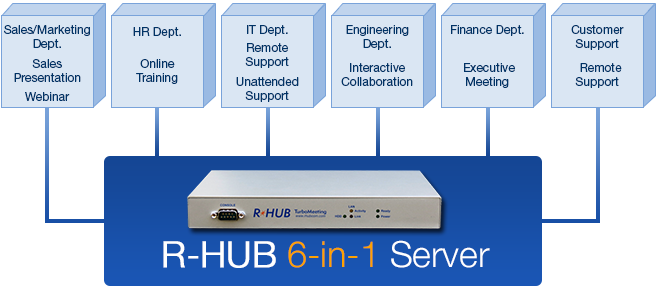
The six product lines are built upon the following six real-time collaboration applications:

1.  Web Conferencing – Give sales presentations, product demos, and collaborate interactively.

2. HD Video Conferencing – Up to 30 webcams based video conferencing with 1080p and telepresence.

3.  Remote Support – Support PC and Mac users remotely.

4.  Remote Access – Access your office or home PCs from anywhere, anytime.

5. Webinar – Provide online seminars without the need for view-only attendees to download anything.

6.  Audio Conferencing – VoIP mixed with free landline (PSTN) audio conferencing services.

Unlike named licenses from hosted services, R-HUB’s licensing is based on floating licenses, which allows an unlimited number of host users to use the system. The LDAP integration option makes it easy for everyone in an organization to take advantage of the R-HUB server’s productivity features. Each R-HUB server can be paid off with just 3 months of the typical subscription fees charged by hosted service providers.

With hosted services, someone else can find out who your attendees are, where they come from and what your next meetings will be. In some cases, hosted service providers may be required to release this data for legal reasons. With an on-premises R-HUB server, no third party can access this private data. For internal remote access over VPN, all session traffic is protected by organization firewalls, the ultimate security measure.

Similar to routers and switches, each R-HUB server is a sealed and dedicated device optimized to deliver 24 x 7 unattended services to support daily business operations with peace of mind.
With 13 years of development, the R-HUB products have been constantly improved and rigorously tested. R-HUB makes meetings easy. It is one of the fastest and most reliable solutions in the industry. R-HUB products deliver better image quality and faster speed, and are easier to use than the leading brands.

Contact:
Collaboration Technologies LTD
telephone: +44 (0)1925 659 523
email: rhub@collaboration-technologies.co.uk

Tuesday, 5 July 2016

Web Conferencing and Security: Hosted Services Solutions versus On Premise Server Solutions.

Security is one of the most important issues of web conferencing. Is your web conferencing service as secure as you think? Let’s have a look at the different available technologies and the security implications of each one.

How much time do you spend on thinking about the security issues of your web conferencing service? Maybe much more time than before after the Panama papers. Have a look at Wikipedia, you will discover that the countries implied in this scandal are over 60% of the planet. Scary, isn’t it? And hackers exploited only one of the thousands of vulnerabilities of the net in this case.

Panama papers are a classic example of the kind of problems that are involved in any web based technology. Unfortunately, the web is public by its nature. This is the reason why packs of hackers have been always wandering through the web. So, what to do?

First, let’s start with a simple consideration. There are only two main technologies available for web conferencing, hosted solutions and on-premise server based solutions. The latter are decisively more secure than the first ones.  In fact, hosted solutions rely on the web and are thus rather insecure by their nature. On the contrary, on-premise server based solutions are intrinsically secure, as they do not rely on the web. Simple, isn’t it? This is the reason why many businesses have adopted a kind of hybrid model, they keep on their servers the most vulnerable and strategic services, and put on the cloud the remainder.

Another problem involved with hosted services is their availability. If the service breaks down for any reason, it could be costly for customers. Darren Anstee, director of solution architects at Arbor Networks, takes stock of the situation of web conferencing security in very few and simple words: ‘When data is held internally it is within an organizations own control and they can decide on the level of security to place around that data. Once data moves to a cloud service platform this control is reduced.” [Quote taken from http://www.information-age.com/technology/security/123459135/great-it-myth-cloud-really-less-secure-premise].

So, let’s go for on-premise based web conferencing technology. Though, there are still some issues. First, this solution is not easy to implement. You need a devoted IT team. This increases the risks of human errors, not to mention costs.  In conclusion, on-premise based web conferencing solutions are safer, but expensive. The question arises spontaneously - is there another solution available? Luckily, the answer is yes.

Technologies that merge the advantages of on-premise based solutions and hosted solutions have been developed for more than ten years. One smart example is the technology developed by the Californian brand R-HUB , It is an on-premise based web conferencing solution that solves almost all the traditional issues of hosted web conferencing services. In fact, R-HUB web conferencing servers:
  • They need no IT maintenance;
  • They upgrade themselves;
  • They are self-installing and self-configuring (“plug and play”). No IT team is necessary.
In one sentence, R-HUB’s web conferencing servers do not have the traditional issues of traditional on-premise servers.  And their prices are inexpensive – One time cost only. Free Lifetime Ownership. 

Thursday, 9 June 2016

R-HUB Communications steps up to the plate, Once Again!

As a Distributor for R-HUB for several years now, I can honestly say it is common place that R-HUB listens to its customers suggestions and   requirements, when it involves product and software improvements.

R-HUB customers are aware of the 6-in-1 and the Remote Support appliance, with most customers purchasing the 6-in-1 appliance. However, some customers
did not have the need or requirements to use all the rich features, and only have the need to use just 1 feature.

As I mentioned, R-HUB listened, and now they have introduced individual servers to meet their customers' requirements!

These are the New servers that are available for its new and existing customers.

1. TurboMeeting Web Conferencing Servers
2. TurboMeeting Thin Web Conferencing Servers
3. TurboMeeting HD Video Conferencing Servers
4. TurboMeeting All-in-One Collaboration Servers
5. TurboSupport Remote Support Servers
6. TurboSupport Remote Access Servers
7. TurboSupport Remote Support & Access Servers

Contact a R-HUB Consultant today. Contact us at +44 (0)1925 659523 or email us at ct@collaboration-technologies.co.uk

Thursday, 28 January 2016

With R-HUB Web Conferencing Servers


build_trust


With R-HUB Web Conferencing Servers, you gain the ability to hold fast and easy meetings, instant collaboration and more on desktops, laptops, iPhones, iPads, Windows, MAC, etc. R-HUB Web Conferencing product, TurboMeeting, increases productivity throughout your organization.

Your R-HUB conferencing server gives you the real-time collaboration features you need to keep your company competitive. With R-HUB web conferencing, you can give sales presentations, product demos, and collaborate interactively. TurboMeeting is perfect to meet all of your meeting and collaboration needs with a rich set of features. R-HUB Communications aims to solve escalating cost problems with the TurboMeeting series of conferencing appliances, which not only brings web conferencing services in-house, but also adds remote support, remote control, and remote access technologies.
build_trust


GoToMeeting
GoToMeeting is used for both meetings and web conferences. Three different products are available: GoToMeeting, GoToWebinar, and GoToTraining. All products allow desktop and application sharing, one-click recording, drawing tools, voice conferencing abilities, and more. You can start meetings from Microsoft Office, email, or instant messaging tools. Perhaps best of all, meetings can also be accessed from a MAC, PC, iPad, iPhone, or Android device.
WebEX
WebEx is an excellent service that provides you with unlimited online meetings. With this, you receive high-quality videos, phone conferencing, and mobile access (including the iPad), so that you are able to host and attend meetings while you are on the go. You even gain the ability to have up to 25 people in a meeting and see up to six webcams on screen at the same time. Their online collaboration tools, such as note taking, white boarding, and annotations make it great for working with groups.
MeetingBurner
MeetingBurner is not just a great place to hold online meetings (directly in the browser with no downloads required), it’s also good for hosting webinars and sharing your screen. It includes Skype integration, conference lines, and one-click recording and sharing. You will also receive analytics for your meetings so that you are able to see how your guests interact with your content. Due to its fast load times and easy-to-use interface, it’s one of the most popular services for online meetings. Best of all, the service is free.
Meetin.gas
Meetin.gs allows you to get started in less than 60 seconds and provides you with the convenience of creating new meetings via a bookmarklet in addition to using the website. Not only can you create meetings yourself and participate from any device, but you can create and edit them together with participants. It’s also a great place to edit documents together with a group. Also, anyone can mail in notes and other materials via email.
Jabbster
Jabbster is aimed at people who want to privately keep in touch with family and friends, yet the platform is also well suited to holding online meetings. While it does not provide real-time meetings via video, like MeetingBurner, it does allow you to create private groups where you can share photos, events, and contact info. You will be able to have threaded discussions, which means it’s a lot like having your own private social networking platform with a few additional benefits.
Contact a R-HUB Desktop Video Conferencing Solutions Consultant today to learn more about how we can help you in this arena. Contact us today at +44 (0)1925 659523 or email us at ct@collaboration-technologies.co.uk